Markov chains of destiny
I'm not a religious man. I'm not a religious woman, either. But I believe in destiny, and here's why. But there will be a little math, prepare.
Markov this, Markov that
So imagine all humans on Earth and let's try to describe them mathematically. From this point of view, they are a set of parameters that describe them, let's assume that float numbers would be capable of describing the complexity needed (it's not 100% correct, but let's assume that for now). Those parameters are different things, like color of the eyes, age, job title and so the amount of such parameters is, in fact, infinite. You can easily prove it with if there are two parameters describing a person, their sum also describes a person in some way and so you have one more parameter and so the number of parameters is countable and infinite.
These parameters are infinite vectors, the vectors with infinite number of parameters. The set of these vectors, which represents a person, is constantly changing in time and so through that represents a movement within the linear space of that parameters, like we move around in three-dimensional space, but here the space has an infinite number of dimensions. The person is progressing in their career, starts and ends relationships and moves from one town to another, and so moves our point within the space of parameters.
At every point of time looking in every direction, the person-vector has a certain probability to move in that direction, that is not zero. The closer we look, the more probable a transition is. This means, that, for example, if Susan lives in an Ohio suburb, she will transit to the city and work there, and not out of a sudden show up in Nigeria. The same is correct for career, the probability of a sudden jump from manager to a lead is higher than to a plumber. But is still not zero. If you are familiar with the concept of a wave function, this is similar. The surrounding states form a transition network, the set of mostly probable next state changes in the close time.
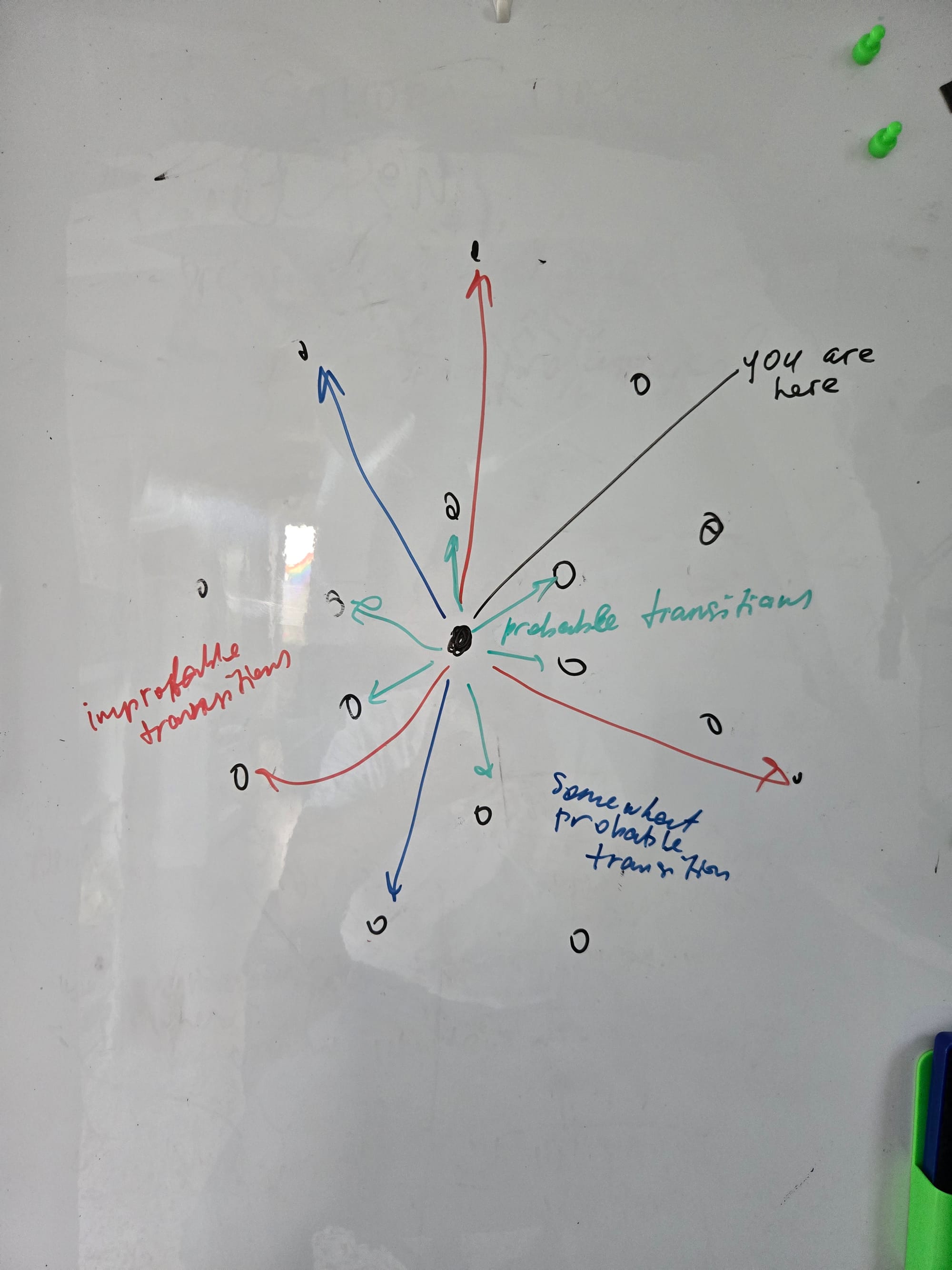
The model for this kind of structure is called a Markov chain. A Markov chain is a directional graph, meaning that all the nodes, which are the states of the person-vector, their particular expressions in the infinite space of person properties, are connected with edges which represent the transition from one state to another and have a beginning and an end. In reality, the model will be even more complex than that, but neither humans nor classic computers can do anything with that.
To understand how this works, imagine an interactive map, where different villages and cities are connected by roads and trains, this is how a two-dimensional projection of the person-vector space would look like. Some of the points on the map will be more visited, than the others, so in our person-vector landscape some points attract more than the others. This is why they are called attractors in the dynamic systems' theory.
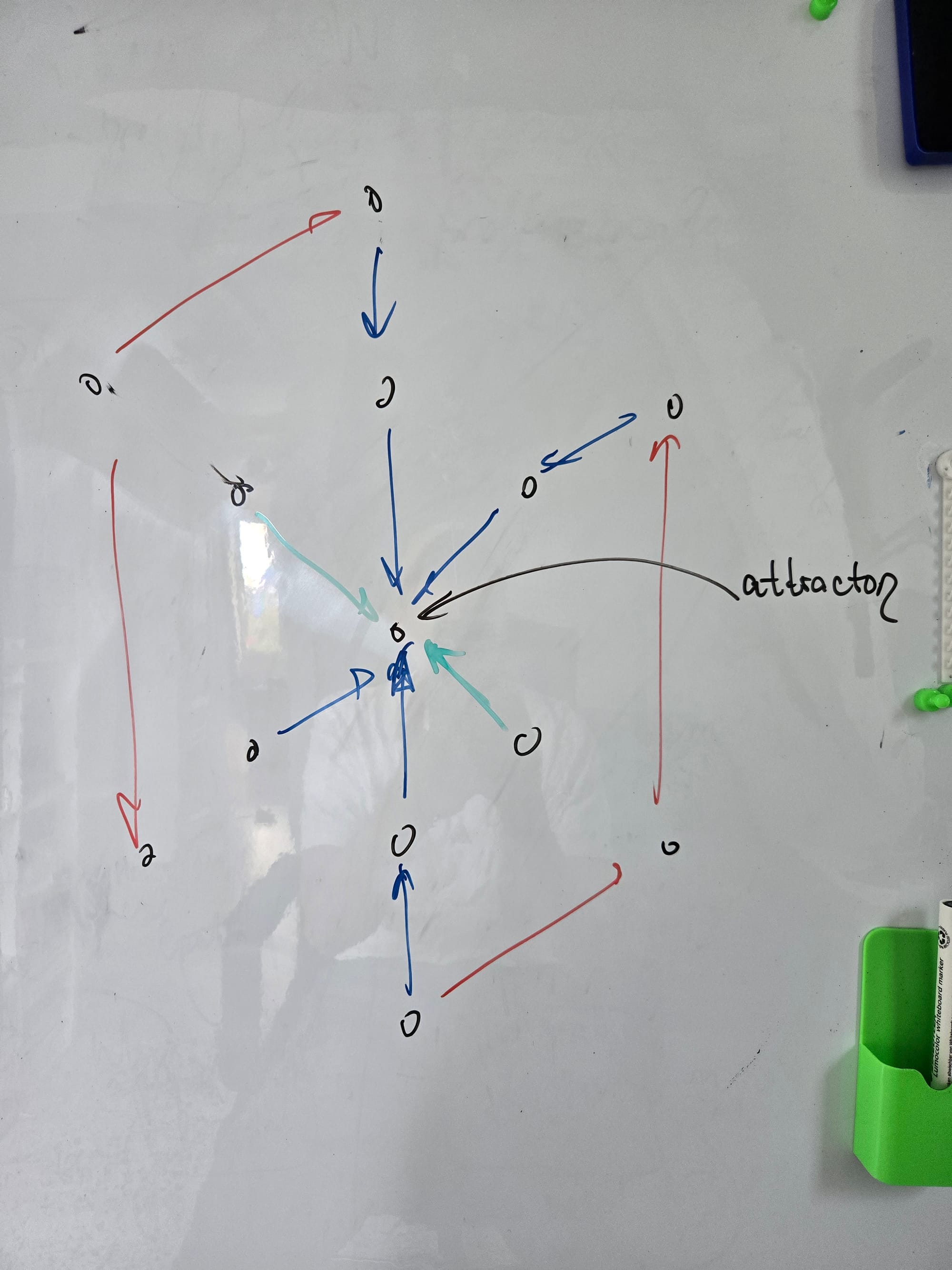
Attractors are inevitable in such a construct like person-vector space, there are some points in life, that are just meant for us to happen. Most of us will probably meet certain people, who are neighbors, friends of our parents or teachers in the local school. We are also meant to go and visit that local school, which is also a set of parameters values in the person-vector space. Those states are not inevitable, but the same as a ship in a vortex, we need to apply significant force, to get out of the attraction field of that special event, the attractor.
Navigating this rocky landscape is life, it has its peaks and valleys, and some of them are larger attractors and are some less so. Going to a specific university, meeting a person meant for us to go in life side by side with, getting sick with a certain disease, dying in specific circumstances - all of that are the attractors in the person-vector space.
And those attractors are indeed destiny.
Reinventing the Wheel of Time
The idea of people being destined for certain things is not new: take the wheel of samsara, the marriage of concepts of reincarnation and inevitable end destination of any soul (no math proof for that, sorry). It is so profoundly explored in the Wheel of Time by Robert Jordan, an omfg 12k page fantasy behemoth, that I'm reading at the moment. Am I getting a hybrid state of mind, quasi religious fantasy zealot?
Isaac Asimov took it to another level with his psychohistory, that he explores in his Foundation series. Not that voluminous, but absolutely surely less engaging, Asimov is not a novelist, better read his short stories. You see, his main shtick is a seemingly blatant buildup and a plot twist in the end, which works perfectly for 30 pages, but doesn't for 300. Wait, where was I?
Asimov psychohistory explores the similar concept of destiny, but he assumes that the behavior of a single individual cannot be predicted and is a subject to a free will. The same as statistics doesn't assume that you will have cancer if you smoke, but it assumes if you take a thousand people who smoke, and female for example, 130 of them will develop lung cancer in life. This is why I don't smoke anymore.
The psychohistory should have predicted the way the entire advanced civilization of the Milky Way galaxy will collapse, although it has been existing for 12000 years to the beginning of the narrative. Hari Seldon, the father of theory, assumes his complex equations can predict the future, even with a certain room for error.
The idea of determination, which is a fancy word for destiny, was explored by the scientists too. A very well-known thought experiment Laplace demon, that was offered by a French mathematician Simon Laplace, the surname very well known to anyone who has ever touched math. In this experiment, Laplace imagines an everything-knowing god like creature, that knows all the equations of the world and all the starting conditions for it. Easier said, it knows how the world works and where it's started. So the Laplace asks: will it be able to see the future? And I, not a French mathematician, add, will it know the destiny of the world?
DESTINY
whoosh whoosh, destiny
In the time when Laplace invented his demon, calculus and classical Newtonian physics ruled the world. The cocky scientists, how many times already, decided that they uncovered all the mysteries of the world and nothing entirely new will come around. So they concluded, if we work hard enough, we'll find all the equations describing the world and create measuring devices precise enough, we'll be able to predict the future of the entire universe.
And we can't blame them, the discoveries of the era, the new mathematical apparatus that was offered at that time were astonishing to the public and to the scientists themselves. Maxwell's equations for electromagnetism, Navier-Stokes equations for aero and hydro dynamics, and the pinnacle of human thought - general relativity theory by Albert Einstein. The humans felt empowered by gods to rule and predict the doom and blessing of their civilization in the quiet rooms on pieces of paper.
And then, quantum theory came around. It not only flipped the half of the physics, until today it's weirdness and counter intuitiveness is boggling the best minds of the world. Einstein himself said:
God does not play dice with the universe.
Quantum mechanics, among other things, tells us that the intrinsic measure of our world, the mechanism of the tiniest particles and forces, the underlying mysterious nanocosmos, lives on its own, probabilistic laws. Nothing is predefined and can change with a non-zero probability. Is this why psychohistory failed?
Bifurcations
The dynamic system knows one more peculiar state: a bifurcation. The bifurcation is nothing different from a splitting of the road, the crossroad, where on our way we have to decide, where we are going to go, and there is no way back, or at least not without a serious effort. A tiny force can tilt the scales in one or other direction. Imagine you are deciding in which university you will study, or where you are going to live, or who you are going to date. In the very moment of choice, your decision can be influenced by anything: random noise, a call or other distraction, and you are pushed toward a life-changing decision in your life. Not always we even register that is happening.
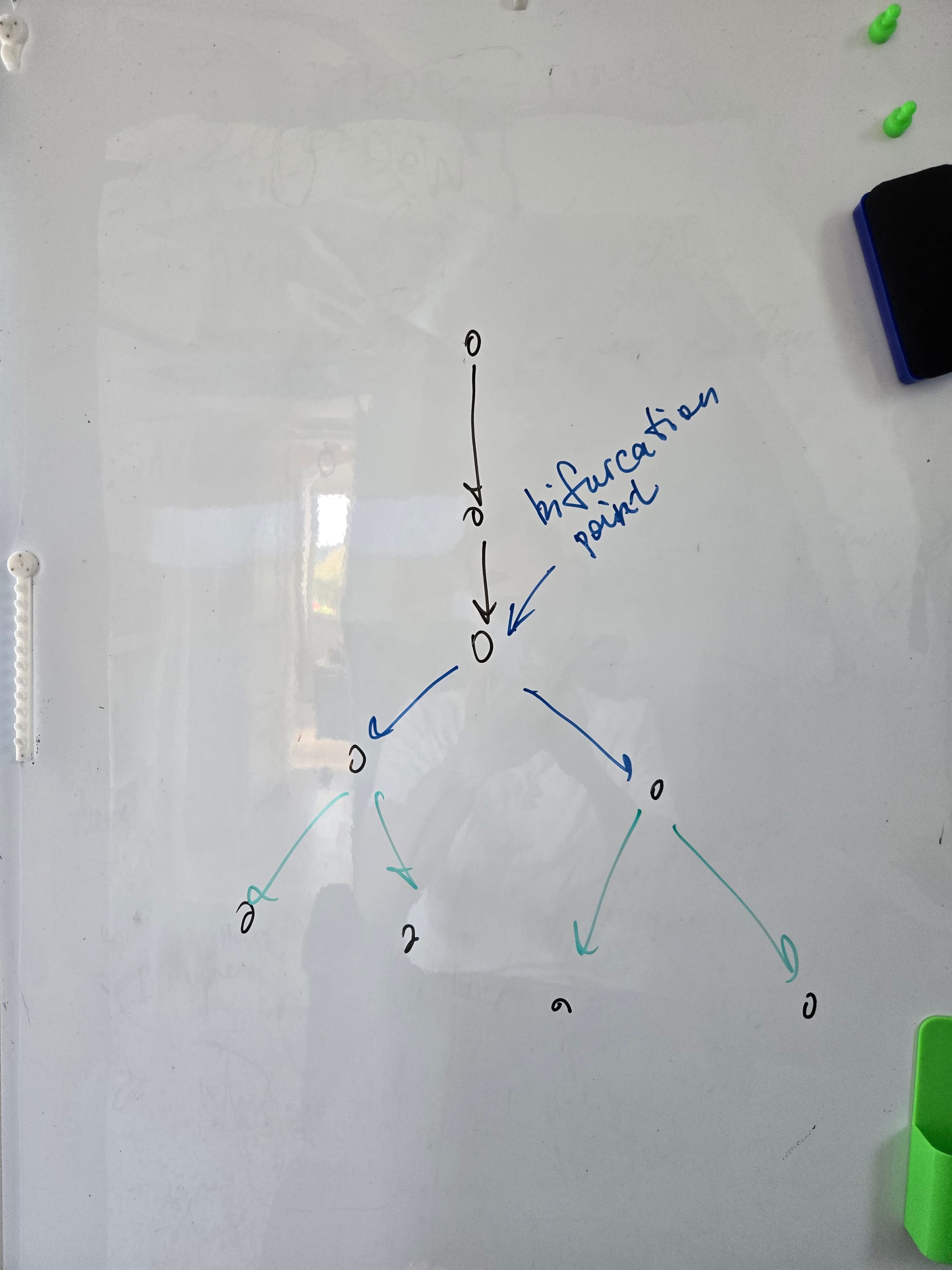
Is that a mathematical manifestation of free will? Does the person-vector Markov chain change depending on our thoughts? Quantum mechanics knows one very peculiar phenomenon: the observer effect. Without going too much into the detail, quantum mechanics postulates, that the very fact of observation can change the behavior of the world.
In the 20th century, the scientists thought that god is a mathematician. Today, they rather agree that he's probably a programmer. We hear more voices, even on the side of a serious science, that the universe might be a simulation. A simulation of what? In Wheel of Time, the ta'veren, the epic heroes with grand destinies, whose will itself can change the way the wheel of time weaves, the way the patterns of human lives interconnect. Is that an observer effect? Maybe the world is not a simulation, but a game? How will you know that you are not an NPC? First, I guess you would know that you are a player. But even if not, like the Rick and Morty's Roy, you would be able to change the way the game goes. Look, he burns Roy's social security number!
Recent discoveries show that neurons use quantum entanglement to synchronize, a long-standing mystery of neurobiology seems to have a solution. Regardless of the fact that today we don't know how that is possible in the physical conditions inside the brain, this sparks a question immediately: is the quantum nature of neurons communication associated with the observer effect? Is our brain a holo-helmet of some advanced human-like super species from another reality?
Simulating the person-vector space
Imagine we have a mathematical model for the person-vector. To build such a statistical device you would require vast data about a tremendous amount of human beings: their locations, preferences and life decisions carefully documented and organized. What does that remind me of? Correct, social networks.
Companies like Meta and Google have enough computational power, money, data and ruthlessness to pull out something like this. And I am sure they already do it. Companies like Palantir collect the data shamelessly. China's authoritarian post-informational dystopian digitalized society even more.
Another challenge would be to calculate the development of such a system. The classical computers we have today aren't even close to achieving something like that. But quantum computers might. Their very nature, calculating variations of a multitude of states in dynamic systems, is what they were created for. Will we see not only AI meets quantum computing cross over, but also totalitarian regime meets quantum computing?