
C.R.A.P. framework: for people with too many ideas
C.R.A.P.
Create. Release. Articulate. Promote.
In 2020, when I had a real crisis with my career as a software developer after a toxic project and management, I decided I needed to find a new way of living. Tech is like heroin, once you are hooked on its easy money, and you are never out, selling your talent, soul and dreams for corporate dollars. Don't get wrong, I like coding, it's just that you'll have no energy for anything else in life.
While idling or just randomly, like maybe many of you, I get a plenty of ideas, and organizing them can be a great challenge. As we all come, the ADHD-crowd is very creative, but easily struggles with filtering the ideas and bring them to execution.
So to learn the proper organization, I tried to analyze the problem as if it were a software development problem. So we have a shaky service, that produces valuable results, those need to be saved properly and their lifecycle needs to be organized. I came up with the C.R.A.P. framework:
In the CREATE phase, every time you come up with something, you backlog it in the tool you like, I prefer Simplenote & Todoist. If you know what a data lake is, it is one. The vessel of raw ideas that might even stay there forever, and that's fine. Many of us know the pressure of those genius ideas to be brought to life, especially at the moment of their birth, but here's the catch: there is only one Ady and there is only one you. All of them couldn't be possibly done in a lifetime, and some of them are better than the others.
You need to filter and prioritize, and I do it on schedule. Every Friday or when I feel like it, I go to the abyss and clear it out, aiming to find the order and filter out obviously crazy ideas. Frankly, I don't remove them so often, sometimes they lie around for years before I stumble upon one of them and think "oh it might be a right time for this one". This is how this blog was born.
Then you pick a task and try to work only on it and bring it to first releasable state. This is when the RELEASE stage comes. Whatever you have created, make it publicly available. Not necessarily for free, just make it accessible for everyone around. Whether it's a library, or just a snippet of code, an artwork, a poem. Don't let it dry out to death on your shelf, which happens to many brilliant ADHiDeas (haha I can't stop), we hop onto the next dopamine source, but discipline is important here. Push it through, make your idea really C.R.A.P.y.
Once the material is ready, it's time to ARTICULATE. When I write this in capital letters and bold them, they look like an SQL statement, I swear. In this phase, you create a meta-material about your idea, in my case, if it was a piece of software, or a library, or some new technique, I would write a technical overview about it. First, it gives our ADHD-brains a hint that the execution is now finished, and we can stop worrying about it. Second, it helps us to structure the result and maybe even think about a continuation, that deserves its own C.R.A.P. loop.
Once the material is ready, it's time to PROMOTE. Start small, take whatever you have in hand or create just a little Instagram account. Let your friends and acquaintances know you've created this. Add a couple of words to it, it may feel awkward, but this is how you finish it up. It lives. It's real C.R.A.P. now!
Touch it
To test the idea, I've built a physical board for my C.R.A.P.:
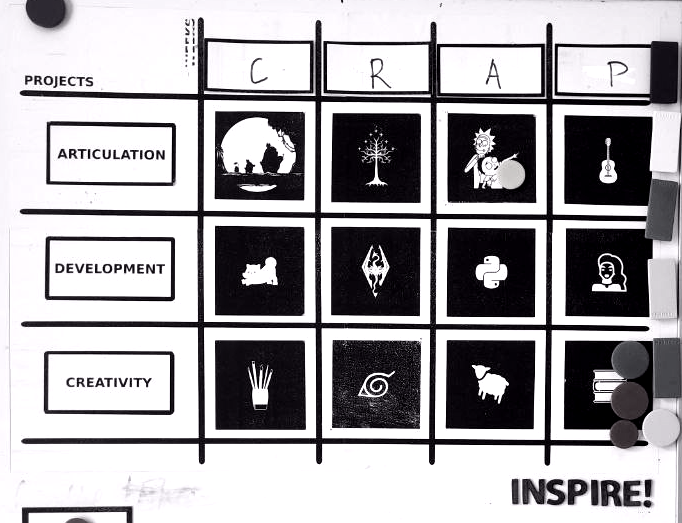
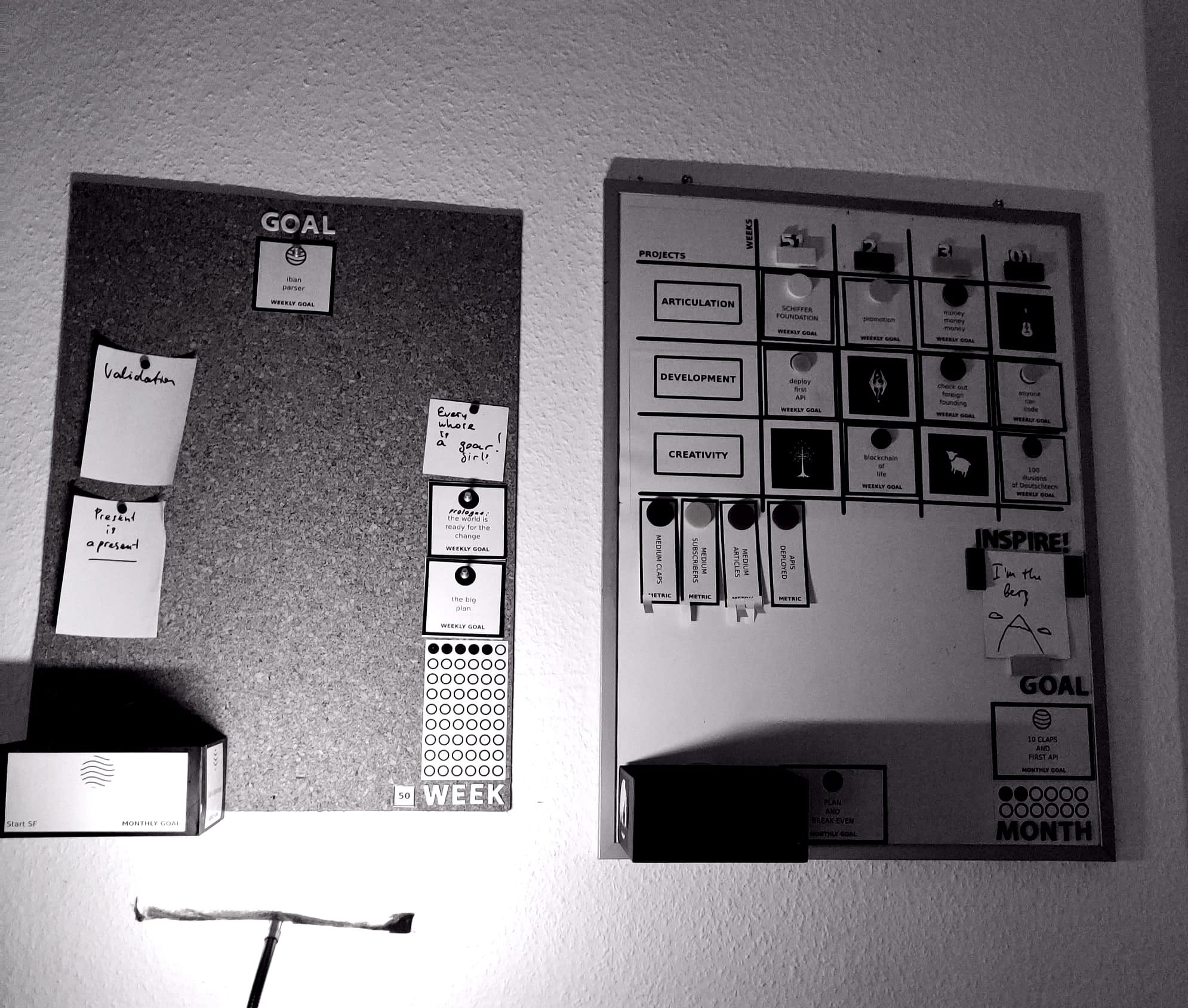
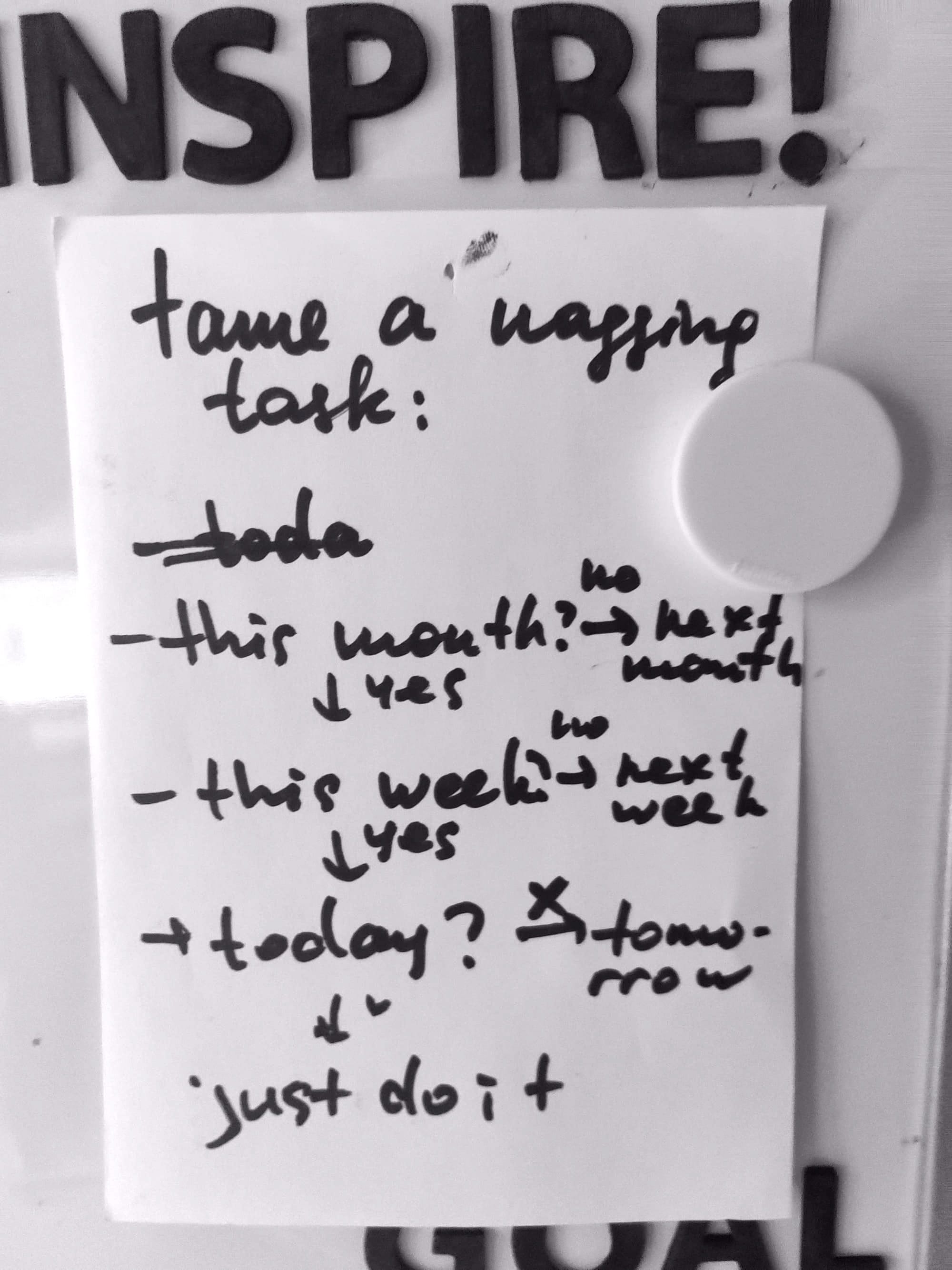
Here are some designs I used for my board:
In rows, you place the projects you want to work on, in columns four stages of the C.R.A.P. framework. Then in each cell, you place an off-work activity that helps you recharge. In my case (left to right), you can see Miyazaki's films, Lord of the Rings, Rick and Morty, guitar, dog, Xbox, Python, Rupaul Drag Race, drawing, anime, my husband and books.
Then you print out the cards fitting the size of the cells and put them on the board in correspondence with their movement to get C.R.A.P.y. You can decide yourselves, what the rules are, but in order not to spread my focus too wide and not to overheat I said: one task in each row and each column. I also usually apply a monthly budget.
When you throw a glance at your board, you'll see where you are currently with your ideas and unfilled cells will remind you to take a break and enjoy life with the things you love. Genius ha?!
Prioritize it
How to decide whether your task should make it to the board and become physical? I've come up with these simple questions, you are free to pick yours:
- is it cool, does it have a wow factor for you?
- will other people find it interesting?
- is it clear what you are talking about?
- does it appeal to a broad audience?
- is it doable, how hard is it to implement it?
- can it wait out an impulse quarantine?
They are all self-explanatory, except the quarantine maybe: ideas may seem good in the moment, but then time passes, and they should still seem doable and viable to you.
Once the tasks are there, how do you prioritize? There are different ways to do it, here is mine: put all tasks in question and then bubble sort them. Bubble sort is one of the simplest sorting algorithms in software development, and it can help you find out the order of things for you. Here is how you do it:
- decide which metric is the one you want to sort your tasks on, for example value
- then take your printed cards and go through them and compare them in pairs. At this point, you only need to compare two distinct tasks, which takes away the analysis paralysis and complexity of making larger decisions in general
- if you can't decide which tasks are "more important" in the sense of your metrics, don't do anything. Treat this situation as if they were equal
- once you reach the end of the stack, start over until there are no cards left to swap
Congrats, you are an algorithm developer!
Alright, my dopamine is over, and I hate this post so much, thanks for reading!